- You’ve built a website. You’re posting on Instagram. Maybe you’re even running ads.
- So why aren’t the leads coming in?
- Most businesses assume they have a marketing problem. But in reality, they have a lead generation problem.
- Getting more traffic isn’t the goal. Getting the right people to take action is.
- The good news? Most lead generation problems can be identified and fixed. Here are the six biggest reasons your business isn’t getting enough leads—and what you can do about them.
1. You’re Attracting the Wrong Audience
- Not everyone who visits your website is going to become a customer. And that’s completely normal.
- The real problem starts when your marketing is trying to attract everyone instead of the people who are actually looking to buy.
- Your content, advertisements, and SEO strategy should all be built around your ideal customer.
- For example, a broad keyword might bring thousands of visitors to your website. But a more specific keyword attracts people who already know what they want and are actively searching for it.
- In other words, don’t focus on getting more traffic.
- Focus on getting better traffic.
- Because a hundred qualified visitors are far more valuable than a thousand people who were never going to buy in the first place.
2. Your Website Isn’t Built to Convert
Imagine spending thousands on advertising only for visitors to land on a slow, outdated website that makes it difficult to contact you. That’s money disappearing before you’ve even had a chance to speak to a potential customer. A business website shouldn’t just exist online. It should guide visitors towards becoming customers.
Some common problems include:
- Slow loading speeds
- Poor mobile experience
- Too much information on one page
- Missing or weak calls-to-action (CTAs)
- Confusing navigation
When someone lands on your website, they should immediately understand three things:
- What you do
- Why they should trust you
- What they should do next
If they have to figure it out themselves, they’ll probably leave.
3. Your SEO Strategy Stops at Rankings
Ranking on Google feels like a win. But rankings alone don’t generate revenue. A successful SEO strategy is about attracting people who are ready to take action—not simply increasing website traffic.
That means combining:
- Keyword research
- On-page SEO
- Technical SEO
- Link building
- A strong user experience (UX)
When all of these work together, SEO becomes more than a visibility strategy. It becomes a consistent source of qualified leads.
4. Your Landing Pages Aren’t Doing Their Job
Many businesses send every visitor to their homepage. The problem is that a homepage tries to do everything, while a landing page should do just one thing. Every marketing campaign should direct potential customers to a dedicated landing page that’s built around a single objective.
A high-converting landing page usually includes:
- A headline that grabs attention
- Clear customer benefits
- Testimonials or certifications that build trust
- Strong visuals
- A simple contact form
- A clear call-to-action
Even small improvements to a landing page can increase conversions without increasing your advertising budget.
5. You’re Not Tracking What’s Working
One of the biggest mistakes businesses make is relying on assumptions instead of data. Without analytics, marketing becomes guesswork.
You should know exactly:
- Where your leads are coming from
- Which pages generate the most enquiries
- Which campaigns produce the highest return on investment
- Which keywords lead to conversions
- Where visitors leave your website
Tracking this information helps you stop wasting money on strategies that don’t work and invest more in the ones that do. Good marketing isn’t based on opinions. It’s based on evidence.
6. Your Content Doesn’t Build Trust
- People don’t buy from businesses they don’t trust.
- Your website shouldn’t just list your services. It should answer the questions potential customers already have.
- Educational blogs, FAQs, industry insights, case studies, and success stories all help establish credibility before someone even contacts you.
- The more value your content provides, the easier it becomes for visitors to trust your business.
- And trust is often the difference between someone leaving your website and someone becoming your next customer.
Building a Lead Generation System That Works
- Successful businesses don’t rely on luck to generate enquiries.
- They build systems that consistently attract, engage, and convert potential customers.
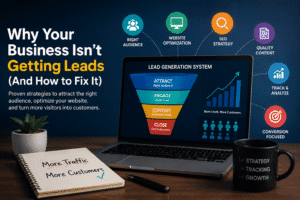
- That means combining SEO, website optimisation, conversion-focused landing pages, valuable content, performance tracking, and continuous improvements based on real data.
- None of these work particularly well on their own.
- But together, they create a marketing system that keeps bringing in qualified leads over time.
- So if your business isn’t getting enough enquiries, the answer isn’t always spending more on advertising.
- Sometimes, the biggest opportunity is improving the marketing system you already have.
Ready to Turn More Visitors into Customers?
- If you’re investing in digital marketing but aren’t seeing consistent results, it may be time to evaluate your entire lead generation funnel.
- At NimbusInfinite, we help businesses improve website performance, strengthen SEO, optimise landing pages, track meaningful analytics, and build lead generation strategies that drive measurable business growth.
- Because getting more traffic is great.
- Getting more customers is even better.