Answer Engine Optimization is changing everything about digital visibility in 2026. If you want to get cited in ChatGPT, Gemini, or other AI platforms, you need to understand how Answer Engine Optimization differs from traditional SEO strategies. This complete guide shows you exactly how to earn AI citations without building a single backlink.
Look, I’m going to be honest with you. I spent years obsessing over backlinks. Building them. Buying tools to track them. Losing sleep when competitors had more than me.
Then something changed.
I started noticing my clients asking different questions. Instead of “How do we rank on Google?” they were asking “How do we show up when people ask ChatGPT about our industry?”
That question stopped me cold. Because I realized I had no good answer.
Fast forward to today, and I’ve spent the last year figuring this out. What I discovered completely changed how I think about search visibility.
Backlinks? They barely matter anymore for AI visibility. Let me explain why Answer Engine Optimization actually works.
What Is Answer Engine Optimization in 2026?
Here’s what’s happening right now. Millions of people have stopped googling things. They just ask ChatGPT. Or Gemini. Or Claude. Or Perplexity AI.
Think about your own behavior. When you need a quick answer, do you scroll through ten blue links? Or do you just type a question into an AI chat?
Exactly.
Answer Engine Optimization is the practice of structuring your content so AI-powered systems recognize, trust, and cite your information. Unlike traditional SEO strategies, AEO focuses on clarity and direct answers rather than keyword stuffing and link building.
According to Search Engine Journal, AI search usage increased by 300% in the past year alone. This shift has created a massive blind spot for most marketing agencies. They’re still playing the old game while the rules have completely changed.
Answer Engine Optimization vs SEO: Key Differences
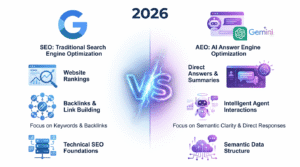
Understanding Answer Engine Optimization vs SEO is crucial for modern digital marketing. Here’s how these approaches differ fundamentally.
Traditional SEO focused on convincing Google your page deserved to rank. You built backlinks. You optimized keywords. You improved page speed.
But AI answer engines work differently. They don’t crawl your site and count your backlinks. They look at something else entirely.
| Factor | Traditional SEO | Answer Engine Optimization |
|---|---|---|
| Primary Signal | Backlinks | Content clarity |
| Content Format | Keyword-rich | Direct answers |
| Success Metric | Rankings | AI citations |
| Link Building | Essential | Not required |
| Update Need | Periodic | Real-time freshness |
The crazy part? You don’t need a single backlink to make Answer Engine Optimization work. I’ve seen brand new websites get cited by ChatGPT while established sites with thousands of backlinks get ignored.
Related: How Content Marketing Drives Results
How Answer Engine Optimization Works for AI Citations
Let me break down what I’ve learned about how Answer Engine Optimization helps you get cited in AI systems.
According to Moz, AI systems evaluate content completely differently than traditional search engines. Here’s what matters:
Clarity matters most. If your content answers a question directly and clearly, you’re already ahead of most competitors. AI hates wading through fluff to find answers.
Structure is essential. Headers that match questions. Lists that organize information. Tables that compare options. This stuff matters way more than keyword density.
Consistency builds trust. Is your brand information the same across the web? Do your author bios show real expertise? Are you mentioned in other places as an authority?
Freshness gets priority. Outdated information gets ignored. Current data gets cited.
Notice what’s missing from this list? Backlinks. Domain authority. PageRank. All that traditional SEO stuff? AI systems largely ignore it.
Related: Building Brand Authority Online
Seven Answer Engine Optimization Strategies That Work
Now let’s get practical with Answer Engine Optimization tactics you can implement today.
Strategy 1: Create Question-Based Content for Answer Engine Optimization
This sounds obvious but most content fails here. People write to rank for keywords, not to answer questions.
AI systems pattern match user questions to content. If someone asks “What does a marketing agency do?” and your page has a header that says exactly that, you’re more likely to get cited.
Structure your content around the questions your audience actually asks. Use those questions as headers. Answer them directly in the first sentence after each header.
Simple change. Big impact for your Answer Engine Optimization efforts.
Related: Our Digital Marketing Services
Strategy 2: Use Schema Markup for Better Answer Engine Optimization
Schema markup is like leaving notes for AI systems. It tells them exactly what your content is about.
Most agencies skip this because it seems technical. That’s a mistake for your Answer Engine Optimization strategy.
According to Schema.org, structured data helps machines understand content context. At minimum, add:
- FAQ schema to your key pages
- Organization schema to your homepage
- Author schema to your blog posts
- Article schema with update dates
You don’t need to be a developer. Most website platforms have plugins that make this easy.
Strategy 3: Build Entity Authority for Answer Engine Optimization
Here’s something most people miss about Answer Engine Optimization. AI systems recognize entities. Your brand is an entity. Your team members are entities.
The more consistently your entity appears across the web, the more AI trusts it.
Make sure your business information is identical everywhere. Create detailed about pages for your agency and team. Get mentioned in industry publications even if they don’t link to you.
Yes, you read that right. Mentions without links still help with Answer Engine Optimization. The AI sees your brand discussed in authoritative places and trusts you more.
Related: About Our Agency
Strategy 4: Write Clearly for Answer Engine Optimization Success
AI can tell when you’re padding content with fluff. It prefers direct, simple explanations.
Start definition paragraphs with the format “[Topic] is…” Use short sentences. Get to the point quickly.
I used to write long introductions before getting to the meat of articles. Now I cut straight to the value. AI rewards this approach, making it essential for Answer Engine Optimization.
Good example:
“Answer Engine Optimization is a digital marketing strategy focused on getting content cited by AI systems like ChatGPT.”
Bad example:
“In the ever-evolving landscape of digital transformation, there exists a paradigm shift…”
Strategy 5: Keep Content Fresh for Answer Engine Optimization
Add update dates to your articles. Refresh statistics regularly. Remove outdated information.
When AI systems browse the web for current information, they prioritize recent content. A page updated last month beats a page from two years ago.
I now audit my top content quarterly. I update numbers, add new examples, and make sure everything reflects current reality. This freshness factor is crucial for Answer Engine Optimization.
Related: Content Update Services
Strategy 6: Target Conversational Queries with Answer Engine Optimization
People talk to AI differently than they type into Google.
Google search: “best marketing agency NYC”
ChatGPT question: “Can you recommend a marketing agency in New York that works with small tech startups?”
See the difference? The AI query is longer, more specific, more conversational.
Create content that addresses these natural language questions. Think about how someone would actually ask for help, then write content that answers exactly that. This conversational approach improves your Answer Engine Optimization results.
Strategy 7: Build Topic Clusters to Support Answer Engine Optimization
AI systems assess your overall expertise, not just individual pages. This makes topic clusters essential for Answer Engine Optimization.
If you want to be cited for marketing topics, you need comprehensive coverage of marketing subjects. Create a main guide, then support it with detailed articles on subtopics.
Link these pieces together. Show AI that you have deep expertise across the entire subject area.
Related Articles:
Measuring Answer Engine Optimization Success
Traditional SEO metrics don’t capture Answer Engine Optimization performance. You need different measurements.
Start by regularly querying AI about topics you cover. Ask ChatGPT questions related to your industry. See if your brand gets mentioned. Track this over time.
According to HubSpot, brand search volume often increases when AI mentions your company. Monitor your brand searches as an indicator of Answer Engine Optimization success.
Check your referral traffic sources. You might start seeing visits from chat.openai.com or gemini.google.com. These are people clicking through from AI citations.
Key metrics to track:
- AI citation frequency
- Brand search volume changes
- Referral traffic from AI platforms
- Share of voice in AI responses
Related: Analytics and Reporting Services
Common Answer Engine Optimization Mistakes to Avoid
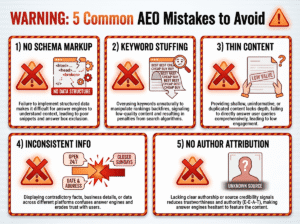
I’ve seen agencies make the same Answer Engine Optimization mistakes repeatedly. Here’s what to avoid.
Ignoring structured data. Without schema markup, AI struggles to understand your content. This is table stakes for Answer Engine Optimization now.
Stuffing keywords unnaturally. AI detects this. It makes your content seem less trustworthy, not more.
Publishing thin content. Short articles without depth don’t give AI enough to cite. Go deep on topics that matter.
Having inconsistent business information. If your address is different on Yelp than on your website, AI gets confused about which is correct.
Writing anonymously. Content without clear author attribution lacks the expertise signals AI values. Put real names and credentials on your work.
Related: Meet Our Team
Combining Answer Engine Optimization with Traditional SEO
I want to be clear about something. Answer Engine Optimization doesn’t replace SEO. Both matter.
Google still drives massive traffic. You still need to rank there. Traditional SEO isn’t dead.
But if you only do SEO and ignore Answer Engine Optimization, you’re missing a growing audience. More people use AI search every day. That trend isn’t reversing.
Smart agencies optimize for both channels simultaneously. Much of the work overlaps anyway. Clear content helps with Google and AI. Structured data helps with both. Authority signals matter everywhere.
Think of Answer Engine Optimization as adding a new channel to your visibility strategy, not replacing your existing efforts.
Related: Complete SEO Services
Your Answer Engine Optimization Action Plan
Let me give you a simple starting point for implementing Answer Engine Optimization.
Day 1-2: Audit your top five pages. Are they structured around questions? Do they have schema markup? Do they have clear author information and update dates?
Day 3-4: Pick your most important service page. Rewrite it with Answer Engine Optimization principles. Add FAQ sections. Make answers direct and clear. Implement schema markup.
Day 5-7: Start monitoring. Query ChatGPT about your industry. Document whether you get mentioned. Check again in a month after making changes.
This isn’t complicated work. It just requires shifting your thinking from keywords to questions, from backlinks to clarity, from rankings to citations.
Related: Get Started With Us
Conclusion: Master Answer Engine Optimization in 2026
The agencies that adapt to Answer Engine Optimization now will have a massive advantage. Most competitors haven’t figured this out yet. They’re still chasing backlinks while the game changes around them.
You have a window of opportunity. Use it.
Start restructuring your content for AI visibility. Build your entity authority. Create clear, direct answers to the questions your audience asks.
Do this consistently and you’ll start showing up when people ask AI about your industry. No backlinks required. Just smart, structured, trustworthy content following Answer Engine Optimization best practices.
That’s the new game. Time to start playing.
Ready to implement Answer Engine Optimization for your agency? Contact us today to discuss your AI visibility strategy.
Frequently Asked Questions About Answer Engine Optimization
What exactly is Answer Engine Optimization?
Answer Engine Optimization is the practice of creating content that AI systems like ChatGPT and Gemini want to cite. It focuses on clarity, structure, and authority rather than traditional ranking factors like backlinks. According to Search Engine Land, AEO is becoming essential for digital visibility.
How is Answer Engine Optimization different from SEO?
Answer Engine Optimization focuses on AI citations while SEO focuses on Google rankings. AEO prioritizes content clarity and entity authority. Traditional SEO prioritizes backlinks and keyword optimization. Both approaches can work together for maximum visibility.
Do I need backlinks for Answer Engine Optimization?
No. For AI visibility specifically, backlinks matter very little. Answer Engine Optimization works by evaluating content quality, structure, and entity authority instead. Well-organized content with zero backlinks can absolutely get cited by AI systems.
How can I check if my Answer Engine Optimization is working?
Query ChatGPT and Gemini about topics you cover. Ask follow-up questions about sources. Monitor referral traffic from AI platforms. Track whether brand searches increase over time. These metrics indicate Answer Engine Optimization success.
Should I stop doing SEO and only focus on Answer Engine Optimization?
No. Continue optimizing for Google while adding Answer Engine Optimization to your strategy. Both channels matter. Much of the work benefits both anyway since clear, authoritative content performs well everywhere.
How long does Answer Engine Optimization take to show results?
Some Answer Engine Optimization changes show results within weeks. Building strong entity authority takes longer, usually three to six months. Start with quick wins like schema markup and question-based headers while building authority over time.